
First of all when it comes to guitar tuning, I have noticed a lot of beginner guitarists are unsure of the pitch that should be produced by each string. This can lead to a frustration and string breakage. To help you with this, I would advise purchasing an electronic chromatic tuner.
In ‘standard’ guitar tuning, the thickest string is known as the ‘6th string,’ ‘low E’ or ‘bottom E.’ This is obviously the lowest pitched string on the guitar and as you hopefully guessed, should sound the note E when strummed or picked.
If the tuner displays another note when you play this string, it is indicating that it is not in tune. You should adjust accordingly by tightening or loosening the machine head, also known as a ‘tuning peg.’ Should the tuner display notes such as D or Eb, the string is too flat, which means it is lower than it should be and the machine head needs to be tightened. A reading of F, F# or higher notes shows that the string is too sharp, or tuned too highly, and so you should loosen the tension.
Here is a chromatic scale over two octaves. It will help if you familiarise yourself with its repeated arrangement and the location of each guitar string over the two octaves.
C C# D E♭ E (6TH) F F# G G# A (5TH) B♭ B C C# D (4TH) E♭ E F F# G (3RD) G# A B♭ B (2ND) C C# D E♭ E (1ST) F F# G
Once you have adjusted the string to produce an E signal on the tuner display, you will need to fine tune it. On playing a perfect note, the digital needle will be central, and most tuners will use a green LED or backlit screen to emphasise that the string is in tune. If the needle is pointing more towards the left then the string is too flat, to the right is indicating that it is too sharp. Adjust accordingly at the machine head until the tuner display is stating that your Low E is in tune.
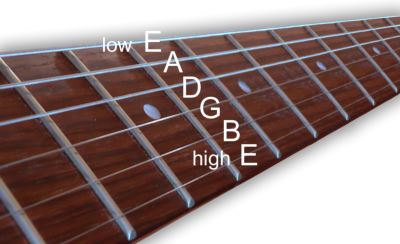

Continuing on with our guitar tuning, you now need to tune the other five strings of your guitar in the same fashion. Move on to the ‘A string,’ also known as the ‘5th’ string. In the same manner as the 6th string, if any notes such as G#, G or lower are produced, the string is too flat and will need to be tightened. If the tuner is displaying higher notes then loosen the tension accordingly. Fine tune the A note and move on to guitar tuning the 4th string (D), 3rd (G) and 2nd (B).
Finally you will come to the thinnest string, known as the ‘1st string,’ ‘High E’ or ‘Top E.’ Beginner players may not be used to the high tension that this string is under so please take additional care not to over tighten.
Keep up to date with our latest student and tuition news, plus offers and general announcements from staff and tutors at Booths.